
You are standing in your shop or your truck, a customer says they could not get your website to load, and you wonder if the problem is where your site lives. It is a fair question, and most owners never get a straight answer because hosting sounds technical.
Here is the short answer. Web hosting in Canada is a good choice for a business that serves Canadian customers. Your site can load faster for people nearby, support speaks your language and works your hours, you pay in Canadian dollars, and you know which country’s privacy rules apply to the information your customers send you. It is not magic, though, and a Canadian address alone does not make a host good. The rest of this post shows you what to look for.
Understand Why Website Hosting in Canada Matters
Hosting is simply the computer, called a server, that stores your website and sends it to visitors. Every time someone in Innisfil, Barrie or Newmarket opens your site, that server answers. Where it sits and who looks after it affects several everyday things.
Faster Pages for Customers Nearby
Information travels quickly, but distance still counts for something. A site stored close to your customers has a shorter trip to make. For a plumber in Alcona or a salon in Bradford West Gwillimbury, almost every visitor is in Ontario, so a server in Canada is the natural fit.
Speed also depends on how your site is built, how big the photos are and how well the server is looked after. Hosting location helps, but it is one piece. A heavy site on a nearby server can still feel slow.
Canadian Dollars, Canadian Hours
A Canadian host usually bills in Canadian dollars, so you are not guessing at exchange rates or foreign card fees on your statement. Support is also more likely to work in your time zone. When your site has a problem at nine on a Monday morning, you want someone awake to answer.
Where Your Customers’ Information Sits
Your contact form collects names, phone numbers and sometimes details about a job or an appointment. That information is stored on your host’s servers. Many owners feel better knowing it sits in Canada under Canadian rules, and some customers, such as clinics, law offices and anyone handling sensitive details, may expect it. If this matters to your business, ask the host in writing where your data is stored and where the backups go.
Compare Web Hosting Canada Cost, Plans and Price
Searches for web hosting Canada cost, price and cheap plans all come down to the same worry: am I paying too much, or too little? The answer depends on what you are actually buying.
Shared Hosting, VPS and Managed Hosting
Shared hosting puts many sites on one server. It is the lowest price, and it works for a simple site, but a busy neighbour on the same server can slow you down. A VPS (virtual private server) gives your site its own slice of a server with guaranteed room to work. It is more flexible, but someone has to set it up, secure it and update it. Managed hosting means the host, or your web developer, does that work for you.
Many small business owners do not want a VPS to manage. They want a website that works and a person to call. That is a reasonable thing to ask for, and it is worth paying for.
Cheap Is Fine, Until It Is Not
A low monthly price can be a good deal. It can also hide extra fees for backups, email, security or moving your site later. Before you sign, ask what the renewal price is after the first term, whether backups are included, and what happens if you need to restore the site. Our post on 6 mistakes local businesses make when choosing website hosting walks through the common traps.
Check That a Canadian Host Is Legit
People type “web hosting Canada scam” and “is it legit” into Google because switching hosts feels risky, and because a few bad experiences get talked about. Good. A little suspicion protects you. Here is a simple checklist.
- A real business you can reach. Look for a named company, a Canadian address or contact details, and a way to speak to a person, not only a chat box.
- Clear terms. Prices, renewal costs and cancellation should be written plainly.
- You own your domain. Your domain name should be registered in your name or your business’s name, not locked into someone else’s account.
- Backups you can actually use. Ask how often backups run and how a restore works.
- Honest answers about location. If you ask where the server is, you should get a direct answer.
If a host gets vague on any of these, treat that as your answer.
See How We Host Our Own Sites
We would not ask you to trust a setup we do not trust ourselves, so here is how our own works. Our websites, the sites we host and our A.I. answering line run on a server cluster we built and look after ourselves, with nightly backups. Before any change: a backup, one change at a time, and a check that everything answers before we call it done. Cloudflare sits in front for speed and protection.
That routine matters more than any slogan. Most hosting trouble comes from rushed changes, not from the hardware. A backup first means there is always a way back. One change at a time means that if something goes wrong, we know which change did it.
If you want to see what ongoing care looks like, our page on website maintenance and hosting explains it.
See What Hosting Costs With ONLINEid.ca
You should not have to hunt for prices, so here they are as they stand today:
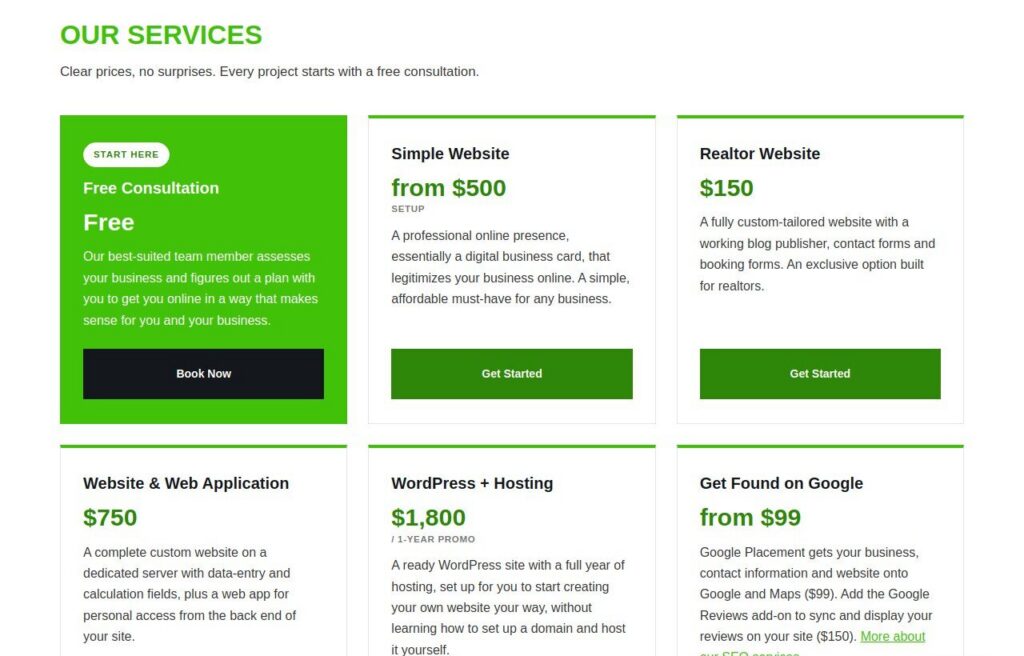
- Free Consultation: free.
- Simple Website: from $500 setup.
- Realtor Website: $150.
- Website & Web Application (custom site on a dedicated server plus a web app): $750.
- WordPress + Hosting: $1,800 (ready WordPress site with a year of hosting, 1-year promo).
- Proxmox Server Setup: from $500, hardware not included.
- Google Placement: $99.
- Google Reviews add-on: $150.
- Website help: the first look is free, then a price for the fix before any work starts.
The full list is on our services and pricing page. If a package does not quite fit your business, tell us what you need on the free consultation and we will make a plan with you.
Plan for DNS, Email and the Day Your Site Goes Down
Three things catch owners off guard, and all three are worth sorting out before you choose a host.
Know Who Controls Your DNS
DNS is the address book that tells the internet where your website and email live. If you ever move hosts, DNS changes are what point your domain at the new home. Make sure you know where your DNS is managed and that you can log in. Our guide to domain name and business email mistakes covers this in plain words.
Keep Email From Becoming an Afterthought
Website hosting and business email often get bundled together, and that is where messages start disappearing. If your enquiry form emails vanish or land in spam, the cause is usually setup, not location. See 7 reasons your website emails and enquiries are landing in spam for the fixes.
Decide What Happens When the Site Goes Down
Every site goes down now and then, whatever the host. What matters is how quickly you find out, who fixes it and whether a recent backup exists. Ask any host those three questions. If your site is struggling right now, our website help and IT support starts with a free first look, so you know what is wrong before you spend anything.
Questions Owners Ask
Does my site have to be hosted in Canada?
No, there is no rule that says every business site must be. But if your customers are in Ontario and Canada, hosting here makes sense for speed, support and clarity about where data is kept. Some businesses, such as health or legal offices, may have extra reasons to insist on it.
Will Canadian hosting help my Google results?
We cannot promise rankings from hosting alone. A fast, reliable site is good for visitors and gives search a healthier foundation, but your content, your Google listing and your reputation do most of the work.
Is cheap hosting a bad idea?
Not always. A simple site with modest traffic can do fine on an affordable plan. Just check renewal prices, backups and support before you commit, and make sure you can leave with your site and your domain.
Can I move my site to a new host without losing it?
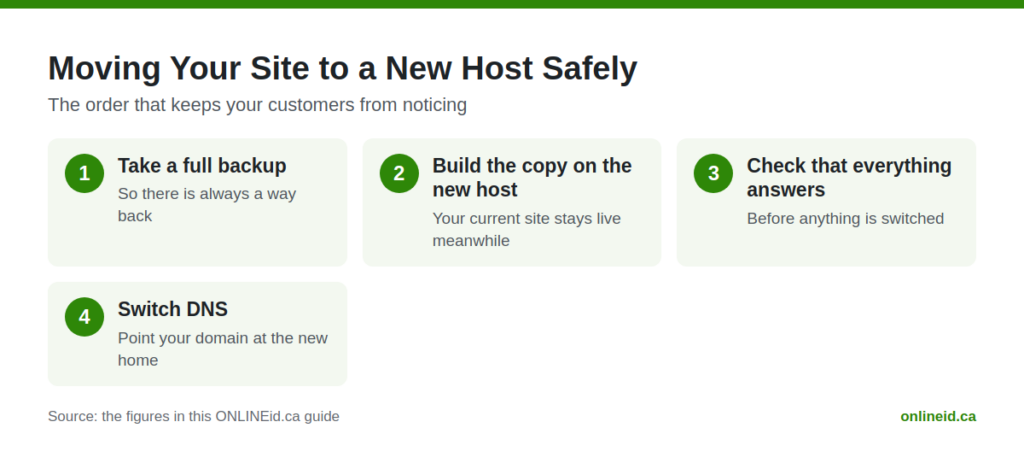
Yes, when it is done carefully. The safe order is a full backup, building the copy on the new host, checking that everything answers, and only then switching DNS. Done that way, your customers should barely notice.

Talk It Through With a Local Team
Choosing a host does not have to feel like guesswork. If you are in Innisfil, Simcoe County or anywhere in the GTA and want a straight opinion on where your site should live, book a free consultation with ONLINEid.ca. A team member will look at your business and make a plan with you.