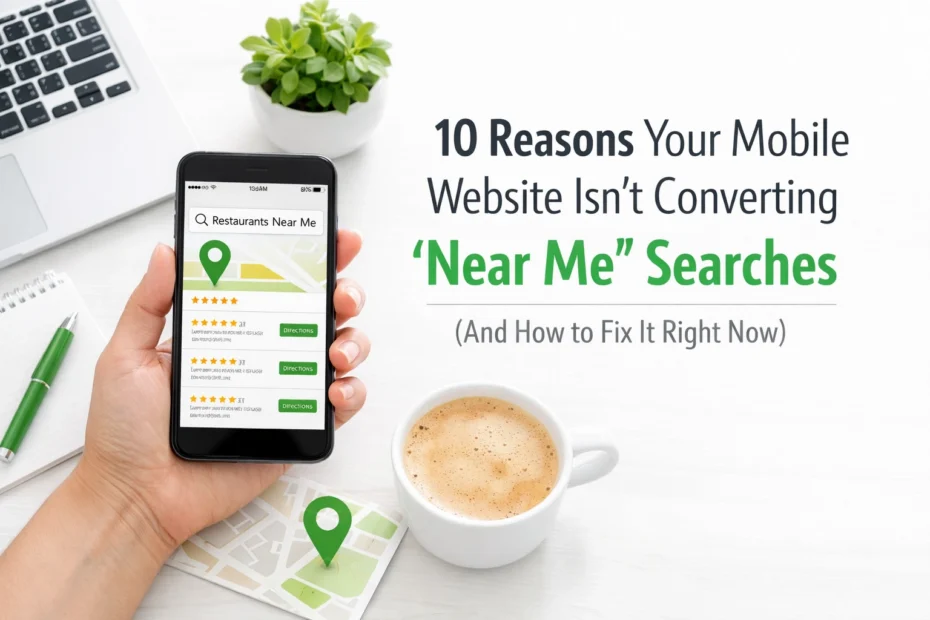
Capturing local customers is more competitive than ever, especially as mobile usage continues to dominate the digital landscape. When someone in your neighbourhood searches for a service followed by the phrase "near me," they are typically ready to take immediate action. This high-intent behaviour represents a massive opportunity for local business owners to secure new leads and sales. However, simply appearing in search results is only the first step of the journey.
If your mobile website fails to provide a seamless experience, those potential customers will quickly bounce back to the search results and choose a competitor. Understanding the importance of having a strong online presence is essential for modern growth. To help you capture these high-value leads, here are 10 reasons your mobile site might be failing to convert and the specific steps you can take to fix them right now.
1. Prioritize Your Page Load Speed
Slow loading times are the primary reason mobile users abandon a website. Most "near me" searches occur when a person is on the go, often relying on cellular data rather than a stable Wi-Fi connection. If your website takes more than three seconds to load, you are likely losing more than half of your potential visitors.
To resolve this, you must optimize your images by compressing them without losing quality. In addition, minimizing the number of redirects on your site can significantly shave off precious milliseconds. Prioritizing Core Web Vitals, which is a set of metrics Google uses to measure user experience, is vital for maintaining your rankings and keeping users engaged. A fast website demonstrates professionalism and respects the customer’s time.
2. Implement Clear Click-to-Call Buttons
Mobile users searching for local services usually want to speak with someone immediately. If a customer has to hunt for your phone number or, worse, try to copy and paste it from a non-interactive text block, they will likely move on. Friction in the contact process is a major conversion killer.
You should place a prominent click-to-call button at the top of every page on your mobile site. This ensures that a phone call is only one tap away. Ensure this button is large enough to be easily tapped with a thumb and is styled in a contrasting colour to make it stand out. Making it easy for people to reach you is one of the simplest ways to increase your conversion rate instantly.

3. Verify Your Google Business Profile Integration
Your website and your Google Business Profile must work in tandem to capture local search traffic. If your profile is unverified or contains information that does not match your website, Google may view your business as less trustworthy. This lack of cohesion can lead to lower rankings in the "map pack" and fewer clicks to your site.
It is crucial to verify your profile and ensure that your name, address, and phone number (NAP) are identical across all platforms. For business owners looking to maximize their visibility, investing in a Google Placement Add-on can ensure your business remains at the top of local listings. Consistency across the web builds authority and makes it easier for search engines to recommend you to local users.
4. Keep Your Business Hours Updated
Nothing frustrates a local customer more than arriving at a business or calling during "open" hours only to find it closed. Inaccurate hours on your mobile site or Google Business Profile signal a lack of attention to detail and can lead to negative reviews.
Regularly audit your hours of operation, especially before holidays or local events. If you offer seasonal hours, ensure these are updated well in advance. Mentioning "Open Now" or "Closing Soon" on your site can also create a sense of urgency for the user. Accurate information is the foundation of a positive customer experience and builds long-term trust in your brand.
5. Develop Location-Specific Landing Pages
If your business serves multiple neighbourhoods or cities, a generic "Contact Us" page is often insufficient. Local customers want to know that you are active in their specific area. Generic content fails to signal geographic relevance to Google, which can hurt your performance in "near me" searches.
Create dedicated landing pages for each primary service area or neighbourhood you serve. These pages should include local landmarks, specific testimonials from customers in that area, and embedded maps. By tailoring your content to a specific community, you improve your chances of appearing in hyper-local searches. This strategy also makes the customer feel that your services are conveniently located for them.
6. Streamline Your Mobile User Interface
A cluttered mobile design is a significant barrier to conversion. When a website is simply a shrunk-down version of a desktop site, buttons are often too small, and text can be difficult to read. Furthermore, intrusive pop-ups that are hard to close can cause users to leave your site in frustration.
Adopting a responsive design is essential. This ensures that your website layout adjusts automatically to fit any screen size. You should also simplify your navigation menu to include only the most important links. Focus on a "mobile-first" approach where the most critical information: such as your services, location, and contact options: is accessible without excessive scrolling.
7. Utilize Local Schema Markup
Schema markup is a form of structured data that helps search engines understand the specific details of your business. Without LocalBusiness schema, Google may struggle to display your business hours, price range, or physical location correctly in search results. This technical oversight can prevent you from appearing in the very searches you are targeting.
Implementing LocalBusiness schema markup on your location pages is key. This code tells search engines exactly where you are and what you do. While it is a backend technical fix, the results are highly visible in the form of enhanced search listings. By providing search engines with clear, structured data, you make it easier for them to present your business to the right audience.
8. Showcase Social Proof and Reviews
Potential customers are looking for reassurance before they decide to visit your location or book a service. A mobile site that lacks reviews or testimonials feels anonymous and untrustworthy. In the local service industry, your reputation is your most valuable asset.
You must actively collect and display reviews on your website. Linking to your Google Reviews allows users to see real-time feedback from their neighbours. Displaying a high star rating prominently on your mobile homepage can provide the social proof needed to turn a browser into a buyer. As a result, customers will feel more confident in their decision to choose your business over a competitor.

9. Include High-Quality Local Visuals
A website without photos can feel cold and uninviting. For local businesses, customers want to see what your storefront looks like, who your team is, and the quality of your work. Low-quality or stock photos can actually detract from your credibility because they don't look authentic.
Take high-resolution photos of your actual business location, your staff in action, and completed projects. Visuals help customers orient themselves and recognize your business when they arrive. Authentic imagery builds a connection with the user and helps them visualize the experience of working with you. In addition, optimized images can also appear in Google Image search, providing another entry point for local traffic.
10. Align Content with Local Search Intent
Many businesses fail to convert because their website content doesn't match the urgency of a "near me" search. If your content is too broad or focused on national trends, it won't resonate with someone looking for a "plumber in Barrie open now."
Focus on using location-based keywords and phrases that reflect how local customers speak. For example, knowing how to get your business found by AI search in 5 minutes can give you an edge in the next generation of search. Use phrases like "locally owned," "serving the [Neighbourhood Name] area," or "available for emergency calls." When your content reflects the specific needs and location of the searcher, your conversion rates will naturally improve.
Conclusion
Optimizing your mobile website for local "near me" searches is essential for any business looking to grow in its community. By addressing slow load times, improving contact accessibility, and ensuring your business information is accurate and consistent, you create a frictionless path for new customers. Finally, by integrating social proof and location-specific content, you build the trust necessary to turn a simple search into a loyal client.
Implementing these changes will help ensure that your business remains the top choice for local consumers. Maintaining a modern, responsive, and high-performing website is the most effective way to secure your place in the local market. For more insights on digital growth, you can always browse our blog for the latest tips.
Ready to turn your mobile traffic into paying customers? Call Rachel at 705-998-4126 for a mobile conversion audit.