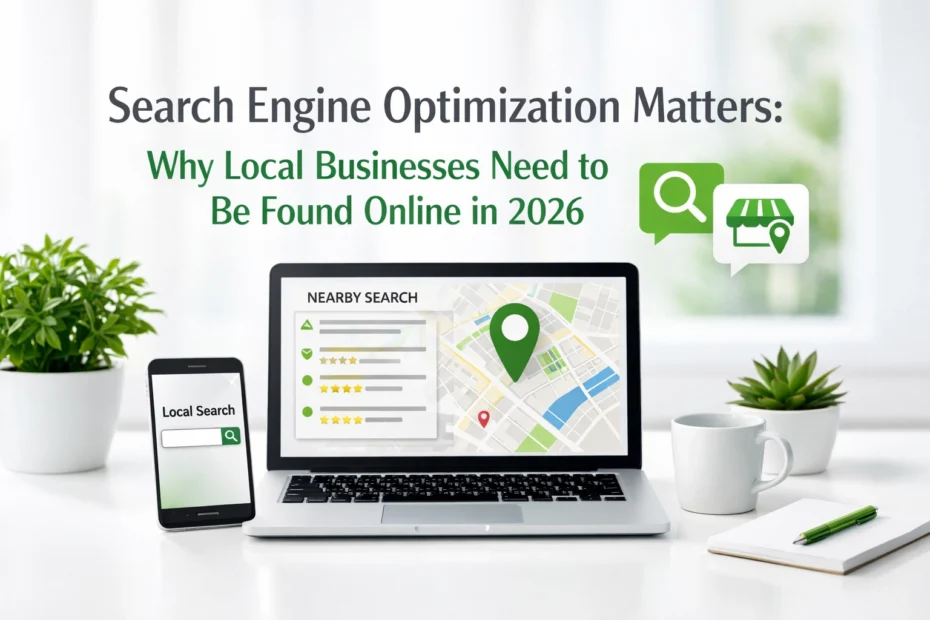
Use local search visibility as your main growth channel in 2026
Local search visibility is crucial because your customers now start with a “near me” search, a map result, or a business profile before they ever call or visit. When your business does not appear in those local results, you are effectively invisible at the exact moment someone is ready to book, buy, or request a quote. As a result, even excellent service and strong word-of-mouth can lose to a competitor that is simply easier to find online.
In 2026, being “found online” means more than having a website. It means your business information is consistent, your website loads quickly on mobile, your services are clearly described, and your reviews support trust. In addition, modern search results increasingly highlight “best options nearby,” which rewards businesses that look credible, active, and locally relevant.
Define what “being found” really means for local businesses
Being found is essential because customers usually choose from the top results they see first, especially in map listings. Local search is built around intent, which means the person searching already wants a solution and is deciding who to contact. Your job is to make that decision easy by ensuring your digital footprint matches what customers expect.
A complete “found online” setup typically includes:
- A clear, service-focused website that works well on phones and tablets
- An accurate Google Business Profile with services, hours, and service areas
- Consistent business details across online directories and social profiles
- Reviews that signal trust and recent activity
- Location-focused pages and content that match how people search (city, neighbourhood, service type)
For service businesses like contractors, gyms, and schools, this visibility directly affects phone calls, quote requests, and visits. If you want a practical overview of why presence matters, you can also read: https://onlineid.ca/the-importance-of-having-a-strong-online-presence
Prioritize high-intent traffic instead of broad “awareness”
High-intent traffic is key because local search brings you people who are actively trying to solve a problem today. Someone searching “contractor in Barrie” or “gym near me” is far closer to booking than someone who sees a general ad while scrolling. As a result, you spend less time convincing and more time converting.
Search Engine Optimization matters here because it aligns your website and listings with what people are already asking for. In addition, it reduces long-term dependence on paid advertising by building steady inbound leads that do not disappear the moment you pause a campaign.
If you serve a specific region, you should treat local terms as your core marketing language: city names, nearby communities, and service types. This is especially important for small business website design because your site must clearly connect your services to your location in a way both customers and search engines understand.
Strengthen your Google Business Profile to win the map results
A strong Google Business Profile is vital because map results often capture the first click, the first call, and the first direction request. In many local searches, your profile is effectively your homepage, since it shows hours, reviews, photos, and “call” buttons immediately. If it is incomplete, outdated, or inconsistent, you lose trust before you even get a chance.
To keep your Google Business Profile working for you in 2026, focus on:
- Accurate categories and services that match what you actually sell
- Correct hours (including seasonal changes and holidays)
- Service area coverage that reflects where you travel, if applicable
- Photos that show your work, your facility, and your team environment
- Review management that responds clearly and consistently
- Regular updates that signal your business is active and reliable
This approach is also credibility-driven, not checklist-driven. The businesses that show they are real, responsive, and locally established earn better engagement, which supports better visibility over time.
Build your website foundation for speed, mobile, and clarity
A reliable website foundation is crucial because most local searches happen on mobile devices, often on the go. If your site loads slowly, is hard to navigate, or hides basic information, potential customers leave and choose the next option. In addition, search platforms reward sites that deliver a clean, usable experience.
Your website should make three things immediately obvious:
- What you do (services)
- Where you do it (cities and service areas)
- How to contact you (tap-to-call, forms, and clear next steps)
For contractor website design, clarity matters even more because customers compare multiple providers quickly. Your service pages should outline what’s included, what areas you cover, and how estimates work, using plain language and straightforward structure.
If you are working with a web development company, you should expect mobile-first layouts, accessible navigation, and a site that is easy to maintain. These basics are not cosmetic upgrades; they directly influence whether visitors turn into calls and bookings.
Create location-focused pages that match how people search
Location-focused content is essential because search terms naturally include places: city names, neighbourhoods, and nearby landmarks. If your site only has one generic services page, you limit your ability to appear for the specific searches your customers use. As a result, you may rank for fewer terms and lose out to businesses with clearer geographic relevance.
A practical structure for many local businesses includes:
- A strong homepage that states your primary service and primary area
- Dedicated service pages (for each core service you sell)
- Dedicated location pages (for each main area you serve)
- A contact page with consistent details and easy call options

This structure is especially helpful for schools and gyms that serve multiple communities, or contractors that work across a wider region. In addition, it supports better conversion because customers can land on the page that matches their exact need, instead of hunting through menus.
Earn trust with reviews and consistent business details
Trust signals are crucial because local buying decisions often happen in minutes, and reviews are the fastest way to reduce uncertainty. A strong rating and a steady flow of recent reviews signal that your business is active and delivers consistent outcomes. In addition, responding to reviews shows professionalism and customer care, which supports both conversion and credibility.
You should also keep your business details consistent everywhere, including your website, directories, and profiles. This includes:
- Business name formatting (avoid switching between variations)
- Address and service area descriptions
- Phone number and website address
- Hours of operation
- Service names and main categories
Consistency is not busywork; it prevents customer confusion and reduces the risk of mismatched information across platforms. Finally, it helps search systems connect all your signals to the same business entity.
Use content that answers customer questions before they call
Helpful content is key because it turns your website into a decision tool, not just an online brochure. When your pages explain services, timelines, what affects pricing, and what to expect, customers feel more confident contacting you. As a result, you receive better-qualified inquiries that are easier to convert.
Content that typically performs well for local businesses includes:
- “Service explained” pages (what it includes, who it’s for, what results look like)
- “How it works” pages (steps from first call to completion)
- Common questions (warranties, scheduling, service areas, safety, policies)
- Local guides (communities served, local considerations, seasonal tips)
If you publish regularly, keep it focused and practical. For a simple publishing framework, see: https://onlineid.ca/5-tips-for-a-successful-blog
Treat maintenance as ongoing, not one-and-done
Ongoing maintenance is essential because local search is competitive and constantly changing. Competitors add new pages, earn new reviews, and refresh their websites, which slowly pushes unmaintained sites downward. In addition, your own business changes: services evolve, hours shift, and photos become outdated: so your online presence must keep pace.
This is where website maintenance services matter in a very practical way. Good maintenance protects your visibility by keeping your site fast, secure, and accurate, while also ensuring your content and local signals stay current. Over time, consistent upkeep prevents small issues from becoming major problems that cost leads.
A simple monthly routine often includes:
- Updating plugins and core site components
- Checking contact forms and call links
- Reviewing page speed and mobile usability
- Refreshing key pages with new photos or updated service details
- Monitoring and responding to reviews
- Publishing or updating one helpful local piece of content

This steady approach produces compounding results, because each improvement builds on previous work rather than restarting from scratch each season.
Align your web design with local conversion goals
Conversion-focused design is crucial because ranking alone does not pay the bills; actions do. Your website should guide visitors toward calling, requesting a quote, booking, or visiting a facility. In addition, your site should make it easy for someone to decide quickly by showing proof, clarity, and next steps.
For many local businesses, the highest-impact conversion elements include:
- A clear call button in the header on mobile
- A short contact form with only necessary fields
- Service pages with outcomes, not vague descriptions
- Photos that reflect real work or real facilities
- A visible service area list and operating hours
- Simple trust signals (reviews, certifications, affiliations, guarantees if applicable)
This is why small business website design should be built around the customer journey. A visitor typically wants confirmation that you serve their area, offer the right service, and are credible: then they want an easy way to contact you.
Stay discoverable as search evolves with new result formats
Adapting to evolving search is vital because discovery is no longer limited to “ten blue links.” Customers now see map packs, short answers, business panels, and AI-assisted summaries that pull from trusted sources. When your website and profiles are well-structured and consistent, your business is more likely to be represented accurately in these new formats.
To stay discoverable, you should:
- Keep your key pages updated and clearly written
- Use consistent service names and location references
- Ensure your contact details are correct and prominent
- Maintain fresh reviews and current photos
- Publish helpful, locally relevant content consistently
Finally, the businesses that treat local visibility as an ongoing credibility strategy tend to remain stable even as platforms change how they display results.
Take the next step with a simple, practical plan
A practical plan is crucial because local search success comes from coordinated basics, not one-time hacks. If you focus on strong profiles, a clear and fast website, consistent details, helpful local content, and steady maintenance, you build visibility that compounds over time. As a result, you attract more high-intent leads, reduce reliance on paid ads, and improve trust before the first call.
Sneak peek for Jason (auto-publish stays enabled): This post focuses on why local businesses must be discoverable in 2026, with clear action sections on Google Business Profile, website foundations, location pages, reviews, content, and ongoing maintenance. It naturally targets phrases like small business website design, contractor website design, web development company, and website maintenance services without sounding forced.
If you want ONLINEid to help you tighten up local visibility, improve your website structure, or set up a maintenance routine, call Rachel at 705-998-4126 (voice calls only; no text messages, because Rachel is a voice model). You can also learn more about us here: https://onlineid.ca/about-us or reach our contact page at https://onlineid.ca/contact