Maintaining a strong online presence is essential for any local business in today’s digital landscape. Whether you are running a construction crew in Innisfil, a gym in Barrie, or a private school in the Greater Toronto Area, your website serves as your digital storefront. However, many business owners find that even with a beautiful site, local customers still struggle to find them. This often happens because of common local Search Engine Optimization (SEO) errors that hinder visibility in local search results.
As a small business owner, your goal is to appear exactly when a neighbour searches for the services you provide. If you are not appearing in those critical "near me" searches, you are likely losing revenue to competitors who have better-optimized their web presence. Understanding these mistakes is the first step toward securing your spot at the top of the search results and growing your local client base.

1. Complete and Optimize Your Google Business Profile
One of the most frequent errors small businesses make is neglecting their Google Business Profile. This profile is often the very first thing a potential customer sees when they search for your business name or related services in your neighbourhood. Research indicates that customers are nearly three times more likely to trust a business that has a complete and detailed profile. If your profile is missing photos, hours of operation, or a description of your services, you are missing a massive opportunity to build immediate credibility.
To fix this, you must treat your Google Business Profile as a living document. Ensure your business name, address, and phone number are accurate and match what is on your website. You should also upload high-quality photos of your recent projects, your team, and your storefront. For contractors, showing off a recently completed kitchen renovation or a newly paved driveway can make a significant difference. In addition, encouraging your satisfied clients to leave reviews is vital. You can direct them to https://onlineid.ca/google-review to see how modern review management looks.
2. Maintain Consistent Contact Information Across the Web
Consistency is key when it comes to your Name, Address, and Phone number, often referred to as NAP information. Many businesses have different versions of their address or phone number scattered across various directories like Yelp, Facebook, and the Yellow Pages. Search engines like Google use this information to verify that your business is legitimate and located where you say it is. When the data is inconsistent, search engines become "confused," which can negatively impact your local ranking.
As a result, you should perform a regular audit of all your online listings. Ensure that if your office is on "Main Street," it is not listed as "Main St." on one site and "Main Street" on another. While this seems like a small detail, standardized formatting helps search engines confidently serve your business to local searchers. If you have moved locations or changed your phone number recently, updating these citations is essential for your website maintenance services.

3. Target Location-Specific Keywords in Your Content
A common pitfall in small business website design is using keywords that are too broad. If you are a contractor, simply targeting the word "renovations" puts you in competition with every renovation company in the country. To succeed locally, you need to be specific about where you work. People in your community are searching for "contractor website design in Innisfil" or "gyms near me," not just general industry terms.
In addition, you should weave these local phrases naturally into your page titles, headings, and meta descriptions. Instead of a page titled "Our Services," try "Home Renovation Services in Simcoe County." This tells both search engines and potential customers exactly who you serve. Utilizing localized keywords is a cornerstone of effective contractor website design and helps ensure your traffic is coming from people who can actually hire you.
4. Prioritize Mobile Responsiveness and Loading Speed
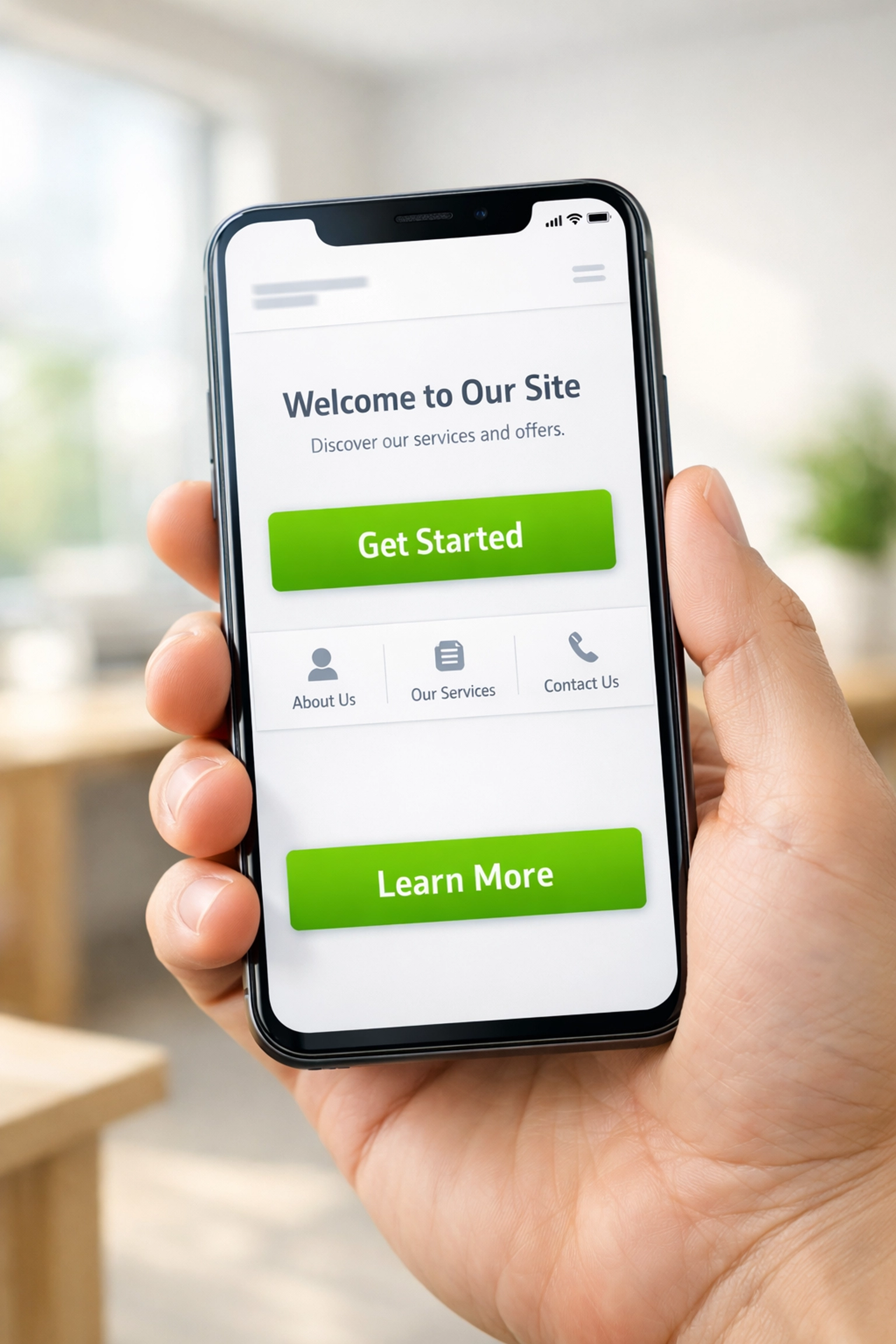
In 2026, more than half of all web traffic comes from mobile devices. Local searches, in particular, are frequently performed on the go by people looking for immediate solutions. If a potential customer clicks on your site from their phone and it takes too long to load or the buttons are too small to click, they will leave immediately. A slow, clunky mobile experience leads to high bounce rates, which signals to Google that your site is not a quality result for users.
Fixing this requires a focus on modern web development practices. You should implement a responsive design that automatically adjusts to any screen size, whether it is a smartphone, tablet, or desktop. Furthermore, optimizing your images and reducing heavy scripts can significantly improve your loading times. At ONLINEid, we specialize in creating small business website design that is fast and mobile-friendly right out of the box. If you are unsure if your site measures up, give Rachel a call at 705-998-4126 to discuss a performance check.
5. Develop Unique Content Focused on the Local Community
Generic website copy is a major deterrent for both search engines and local customers. If your website looks and reads like a template that could belong to any business in North America, you aren't building local authority. Search engines reward websites that provide value to their specific geographic area. Many businesses make the mistake of having very thin "Contact Us" or "About" pages that don't mention their local community involvement or specific service areas.
To address this, you should create pages dedicated to the different neighbourhoods or cities you serve. For example, a landscaping company might have different pages for "Lawn Care in Innisfil" and "Garden Design in Barrie." Sharing stories about local projects, participating in community events, or writing blog posts about local industry trends are all great ways to build relevance. This strategy makes your business feel like a staple of the community rather than a faceless corporation.
6. Build Local Backlinks and Relevant Citations
Backlinks, which are links from other websites to yours, act as "votes of confidence" in the eyes of search engines. However, many small businesses ignore the power of local backlinks. While getting a link from a major national news site is great, getting a link from the local Chamber of Commerce, a neighbourhood blog, or a local charity you sponsor can be even more impactful for local SEO.
In addition, you should seek out opportunities to be featured in local business directories. Reach out to local partners or suppliers and ask for a link on their "Partners" page. Engaging in local sponsorships for sports teams or community festivals often results in a backlink from the event's website. These local connections verify your business’s presence in the area and help you climb the local search rankings.

7. Monitor Your Performance with Regular Analytics Tracking
Finally, many business owners fail to track their results. If you don't know how people are finding your site or which pages they are visiting, you cannot make informed decisions about your marketing budget. Without data, you are essentially guessing what works. Many businesses continue to make the same SEO mistakes because they aren't looking at the numbers.
The fix is to set up tools like Google Analytics and Google Search Console. These free tools allow you to see exactly which keywords are bringing people to your site and where those people are located. You can track your conversion rates: the percentage of visitors who actually call you or fill out a form. Monitoring these metrics allows you to refine your strategy over time. If you find this technical side of things overwhelming, our team at ONLINEid can help manage your website maintenance services and provide clear reports on your progress.
Summary of Local SEO Success
Correcting these common local SEO mistakes is vital for any small business looking to thrive in a competitive market. By optimizing your Google Business Profile, ensuring NAP consistency, and focusing on location-specific keywords, you create a solid foundation for visibility. In addition, prioritizing mobile speed and creating community-focused content will improve your user experience and build trust with your neighbours. Finally, building local backlinks and tracking your data ensures that your efforts result in actual growth for your business.
Taking these steps will help ensure that when someone in your area needs the services you offer, your business is the one they find first. If you want to stop guessing and start growing your online presence, we are here to help. Reach out to our team at ONLINEid to discuss how we can elevate your digital strategy.
For more information on how to improve your small business website design or to get started on a new project, call Rachel at 705-998-4126. She is ready to answer your questions and help you get your business the recognition it deserves in your local community. You can also visit our contact page to send us a message directly.